
Ever wonder why some people bounce back stronger after failure while others just give up?
It’s not just luck or talent — it’s mindset.
That quiet voice in our heads that says, “I can’t do this” or “I’ll figure it out somehow.”
That’s what really separates a fixed mindset from a growth mindset.
What Is a Fixed Mindset?
A fixed mindset is the belief that our abilities, intelligence, or talent are set in stone.
People with this mindset tend to think, “I’m just not good at math,” or “I’ll never be as creative as her.”
It’s like they’ve drawn a line around what they can do — and refuse to step beyond it.
Carol Dweck, the psychologist who first introduced these concepts, described fixed mindset individuals as people who see effort as useless if you’re not “naturally good” at something.
So instead of taking challenges as opportunities to grow, they often avoid them.
Because failure, to them, feels like proof that they’re not smart enough.
Here’s how it often shows up in real life:
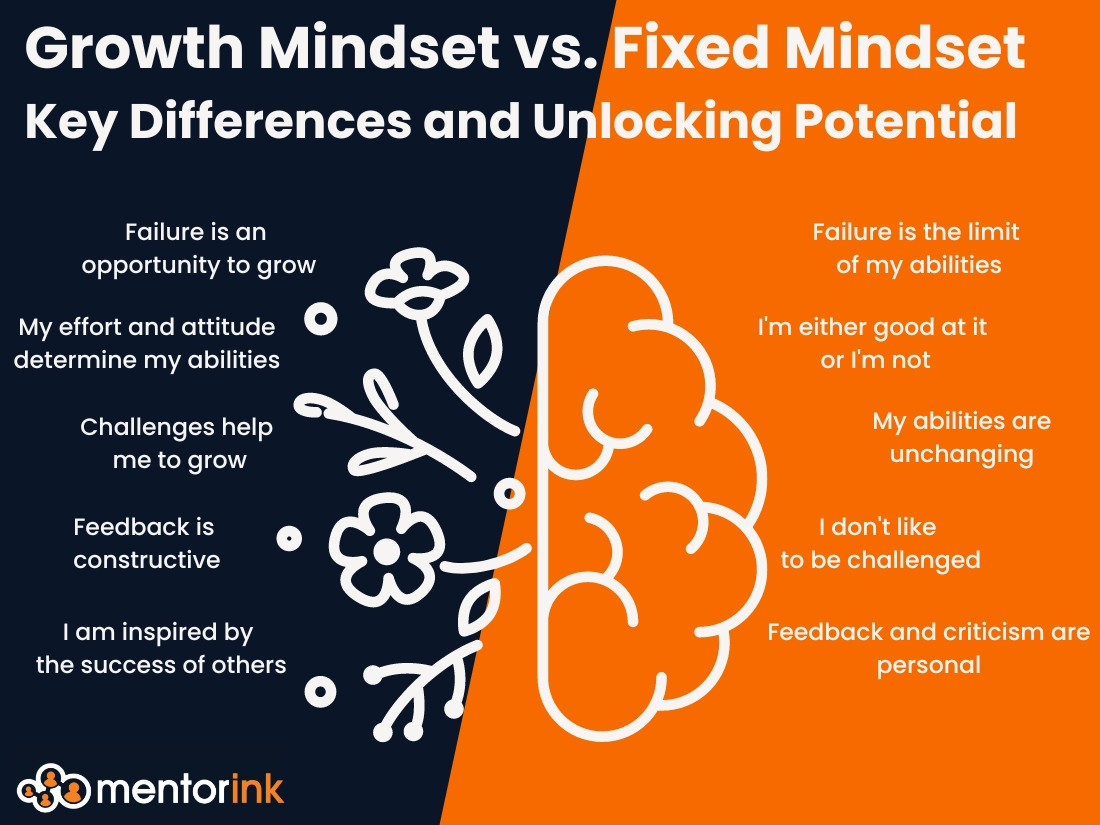
- Avoiding tough tasks or challenges
- Feeling threatened by others’ success
- Giving up easily when faced with obstacles
- Believing talent is everything, effort is secondary
It’s not that they’re lazy or unmotivated.
It’s more like they’re protecting themselves from disappointment.
If your worth is tied to how “smart” or “talented” you appear, failure becomes terrifying.
What Is a Growth Mindset?
Now, flip the script.
A growth mindset is the belief that abilities can be developed — through effort, practice, and persistence.
It’s not about pretending to be great at everything, but knowing you can improve with time.
Someone with a growth mindset might say, “I’m not great at this yet, but I can learn.”
That little word “yet” changes everything.
People with this mindset see failure as feedback — not as a dead end.
They welcome challenges because they know that growth happens when things get uncomfortable.
They ask questions, stay curious, and view effort as the path to mastery.
Some common traits:
- Embracing challenges instead of avoiding them
- Seeing effort as a key to success
- Persisting even after setbacks
- Feeling inspired by other people’s achievements
It’s not about blind optimism — it’s about resilience.
The kind that whispers, “I can improve, even if it’s slow.”
How These Mindsets Shape Our Lives
Mindsets influence more than just how we think about learning.
They quietly shape every corner of our lives — relationships, careers, even how we handle criticism.
For example:
- In school: Students with a growth mindset often perform better over time, even if they start behind. They see mistakes as lessons, not as proof of being “dumb.”
- At work: Employees with fixed mindsets may avoid taking risks or feedback. Growth-minded workers see feedback as a tool for improvement.
- In relationships: Someone with a fixed mindset might think, “We’ll never change,” while a growth-minded partner believes, “We can learn and grow together.”
It’s subtle, but it’s powerful.
Mindset becomes a lens — it colors how we interpret everything that happens to us.
Can You Change Your Mindset?
Yes, absolutely.
That’s the beauty of it — mindsets aren’t permanent.
You can move from a fixed to a growth mindset by catching your own thoughts.
When you hear that voice saying “I can’t,” try adding “…yet.”
Start celebrating effort, not just results.
Notice progress, even the small stuff.
Simple habits help too:
- Reflect on what you learned from mistakes
- Ask for feedback (and actually listen)
- Remind yourself that skills develop through practice
- Surround yourself with people who challenge and encourage you
It’s not about forcing positivity.
It’s about changing the story you tell yourself about your potential.
Why It Matters So Much
In a world that’s changing faster than ever — technology, jobs, even how we communicate — adaptability is everything.
And that’s what a growth mindset really gives you: adaptability.
It’s like mental flexibility.
A fixed mindset closes doors before you even knock.
A growth mindset opens them, even if you’re not sure what’s on the other side.
At its core, the difference between the two comes down to this:
- A fixed mindset says “I am what I am.”
- A growth mindset says “I am becoming.”
And maybe that’s the point — that life isn’t about proving ourselves, but improving ourselves.
Final Thoughts
We all have both mindsets living inside us — it’s not black and white.
Even the most confident people sometimes slip into fixed thinking.
The goal isn’t perfection, it’s awareness.
Because once you start noticing the difference, you can choose to grow.
And that choice, small as it seems, can change everything — your confidence, your success, your happiness.So next time you hear yourself say “I can’t,” pause.
Add “yet.”
That single word might be the bridge between who you are and who you’re becoming.
