
Written for university students in the UK and internationally. Conventions and terms vary between countries and institutions, so your own course handbook and your tutor’s guidance are always the final authority.
Ask students what a literature review is and many will describe a summary of everything written on their topic. That definition is exactly why so many literature reviews disappoint. A review that marches through sources one at a time — “Smith found this, then Jones found that” — is an annotated list, not a literature review. A real review organises the field, shows how studies relate to one another, and builds toward the gap your work will fill. This article focuses on the literature-review chapter of a dissertation or research project; a shorter standalone review shares the same analytical habits, though it need not always build toward a new empirical study of its own.
What a literature review is actually for
A literature review has three jobs. It demonstrates that you know the significant work in your area. It makes sense of that work by organising it, showing where scholars agree, disagree and leave questions open. And, in a research project, it justifies your own study by locating the gap it addresses. If a section of your review is not doing at least one of these jobs, it is probably padding. Keeping these purposes in mind as you write is the simplest way to stop a review collapsing into a summary.
Search and select with a record
A good review rests on a deliberate search rather than whatever turned up first. Decide on your key terms, use your library databases rather than only a general search engine, and keep a record of what you searched and what you kept. You cannot read everything, so you select: prioritise work that is both relevant to your question and methodologically sound, not merely the most recent or the most cited, and follow the references of the most useful papers. Be able to explain why a source is in or out — that record also protects you if an examiner asks how you built the review.
Organise to compare, not to list
The structural key to analysis is to group sources rather than march through them one at a time. Organising around themes or debates is the most common way to do this: build a paragraph around a question or an idea and bring in several studies to show how each addresses it. Theme is not the only valid principle, though — a chronological structure can suit a review tracing how thinking has developed, and a methodological one can suit a review comparing how a question has been studied; choose whichever lets you compare sources best. Either way, if every paragraph is built around a single author, that usually signals listing rather than analysing. An occasional paragraph that opens with a landmark study’s author is perfectly fine; it is the one-study-per-paragraph pattern, not the opening word, that gives listing away.
Synthesise: compare, contrast, connect
Synthesis is the heart of a literature review. It means showing how sources speak to one another: this study supports that one, these two reach opposite conclusions, this later work resolves an earlier debate, these findings hold in one context but not another. Your voice as the writer is in these connections — in the sentences that no single source could have written because they are about the relationships between sources. A synthesis matrix is a simple tool for seeing those relationships before you write.
| Theme | Study A | Study B | Gap / tension |
| Effect of X on Y | Finds a strong effect | Finds no effect | May depend on context |
| How Y is measured | Uses self-report | Uses observation | Scope to combine both |
A synthesis matrix (Study A and Study B here are hypothetical): mapping what each study says under each theme makes gaps and tensions visible before you write. Remember that a gap can only be claimed against the literature you have actually reviewed — it cannot be inferred from two studies alone.
Be critical, not just descriptive
Analysing the literature also means weighing it, not just reporting what it found. How strong is the evidence behind a claim? Was a striking result based on a small or unusual sample? Do the studies actually measure the same thing when they use the same word? A review that notices these differences in quality and definition is doing genuine critical work. You do not need to attack every source, but you should show that you are reading with judgement rather than simply trusting whatever is published.
Lead the reader to the gap
In a research project, everything in the review should build toward the gap your study addresses. By the final section, the reader should see clearly what is well established, what remains contested, and what has not been examined — ideally in your particular context, population or setting. That gap is the hinge between your literature review and the rest of your dissertation: it is what your research question answers. A review that ends by naming the gap in a clear sentence has set up the whole study that follows.
How much is enough?
Students often ask how many sources a literature review needs, hoping for a number. There is no fixed answer, because the real test is coverage, not count: have you included the work a knowledgeable reader in your field would expect to see, and enough to establish both what is known and where the gap lies? A short review that covers the key studies and debates is stronger than a long one padded with marginal sources. Let the field and your question set the scope, and be ready to explain why a source is in or out.
Keep your own voice in the review
A literature review is still your writing, and your voice should be present in it — not as opinion, but as the organising intelligence that decides what matters, groups the studies, and draws out the tensions. The sources provide the evidence; you provide the argument about what that evidence adds up to. If whole paragraphs could have been produced by simply stitching abstracts together, your voice has gone missing. The connecting sentences, the judgements about quality, and the framing of the gap are where you show up as the author.
The mistakes that weaken a review
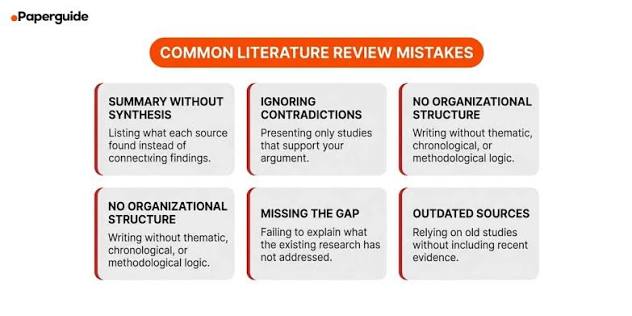
A few recurring faults drag down otherwise careful reviews. Relying too heavily on one or two sources and building the whole argument around them. Treating old studies as current without noting how the field has moved on. Describing findings without ever weighing how good the evidence is. And losing the thread, so the review reads as a tour of the literature with no destination. Checking your draft against each of these is a quick way to catch the problems examiners notice most.
Telling listing from analysing
It is genuinely hard to judge your own review, because you can see the connections in your head even when they never reach the page; a reader can tell you whether the synthesis is really there. academic writing support can give that feedback — whether a review groups and compares its sources and leads clearly to a gap — with the scope agreed first and your university’s rules checked. A strong review is not the longest one; it is the one that turns a pile of reading into an argument.
